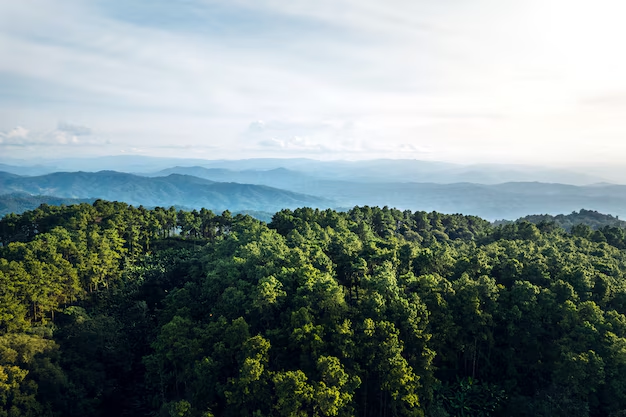
Deforestation Gorontalo has long been one of Indonesia’s biggest environmental concerns, but Gorontalo—an emerging province on Sulawesi Island—is showing a different path. While many regions still struggle with forest loss, Gorontalo is becoming an example of how responsible governance and sustainable industry can protect forests without stopping economic growth.
A New Model for Forest Management
Gorontalo’s strategy to prevent deforestation Gorontalo is simple but effective: manage, monitor, and modernize. Instead of cutting down natural forests for profit, the province focuses on Industrial Forest Plantations (HTI)—areas specifically developed for wood production and biomass.
This approach separates natural forest conservation from industrial needs. The plantations are continuously replanted, ensuring that production cycles do not reduce forest cover. It’s a long-term plan designed to balance the environment and economy.
According to official data, Gorontalo now contributes around 29.96% of Indonesia’s total wood pellet production, a key part of the country’s renewable energy push.
The Role of SVLK: Ensuring Legal and Sustainable Forestry
At the heart of Gorontalo’s forest governance is the Timber Legality and Sustainability Verification System (SVLK). The system ensures that every piece of wood harvested, transported, and traded in Indonesia is legally sourced and sustainably managed.
As Erwan Sudaryanto, Director of Forest Product Processing and Marketing, stated during a Jakarta discussion, SVLK provides a strong legal foundation, independent auditing, and international credibility. It’s not just a local rule—it’s a globally recognized certification system.
With SVLK in place, companies must prove that their wood comes from licensed plantations, not from illegal logging or natural forest clearing. This standard has become essential for trade with markets like Japan, South Korea, and the European Union, which require proof of sustainability for all biomass imports.
Baca juga: Solusi Perjalanan yang Efisien dan Mengesankan
Turning Biomass into a Green Opportunity
Preventing deforestation doesn’t mean stopping forest-based industries—it means transforming them. Gorontalo’s growing biomass industry shows how innovation can reduce pressure on forests while supporting Indonesia’s energy transition.
Between 2020 and 2024, national wood pellet production nearly tripled—from 103,356 cubic meters to 333,971 cubic meters. There are now 35 pellet plants across the country, with a total licensed capacity of 3.18 million cubic meters per year.
Gorontalo’s role is significant: its companies supply renewable biomass materials for clean energy production, replacing fossil fuels while maintaining strict environmental standards.
Preventing Illegal Logging through Monitoring and Transparency
To fight illegal deforestation, Gorontalo integrates monitoring systems, traceability tools, and public audits under the SVLK framework. Every stage of the wood supply chain—from planting to export—is tracked.
These checks are supported by both the government and independent auditors, ensuring that violations can be detected early. This transparent system has not only reduced illegal logging but also improved investor and buyer confidence in Gorontalo’s forestry sector.
Involving Local Communities
Another key factor in preventing deforestation is community involvement. Many of Gorontalo’s residents work directly with industrial plantations, participating in tree planting, harvesting, and maintenance programs.
This model provides steady income and education for rural populations while strengthening the sense of shared ownership over local resources. When communities benefit from sustainable forestry, they are far less likely to turn to illegal or destructive activities for survival.
Local governments also partner with universities and NGOs to train residents in forest monitoring, reforestation, and eco-friendly entrepreneurship—building a culture that values sustainability.
Economic Growth Without Forest Loss
Gorontalo’s success lies in proving that economic growth and environmental protection are not opposites. The province’s green industries generate jobs, exports, and local prosperity—without expanding into natural forest zones.
Indonesia’s forestry authority has mapped out 10.36 million hectares of land suitable for energy crops and industrial plantations. This ensures that the biomass sector can continue expanding without increasing deforestation rates.
By turning forestry into a managed, renewable resource, Gorontalo supports both climate goals and local development.
Deforestation in Gorontalo is being prevented not by stopping activity, but by changing how forestry works. Through SVLK certification, community participation, and renewable industry innovation, the province has built a practical model for sustainable development.
It’s a reminder that environmental progress doesn’t always come from restriction—it often comes from reinvention. Gorontalo’s example offers hope that other regions in Indonesia, and beyond, can protect their forests while still growing their economies responsibly.
Don’t forget to share our article sttbci.ac.id, follow our newsletter. Thank you!
Leave a Reply